When the Clinical AI Forgets: Designing MAPE-K Loops for Model Drift in Pediatric Health Systems
Your pediatric brain health model was accurate at launch. Six months later, it is quietly wrong. Here is why static monitoring is not enough, and what a self-healing control loop actually looks like in practice.
The Drift Nobody Notices Until It Matters
You trained a model on neonatal EEG features to flag early indicators of hypoxic-ischemic encephalopathy. Validation metrics were strong. Clinical stakeholders signed off. You deployed it.
Six months later, the hospital switched EEG hardware vendors. The new amplifier has a slightly different noise floor and a different default low-pass filter cutoff. Your feature pipeline did not change. Your model did not change. But the input distribution did, silently, and your model is now systematically biased toward under-detection in a specific frequency band.
No alert fired. No threshold was crossed. The model is still returning confident predictions.
This is not a monitoring gap. It is a control gap. And it is one of the hardest problems in deploying adaptive AI inside regulated clinical environments, especially when the patient population is pediatric, where feature distributions shift not just with equipment changes but with patient age, developmental stage, and evolving clinical protocols.
Why Standard ML Observability Fails Here
Most production ML observability stacks, whether you are using Evidently, WhyLogs, or a custom solution, are built around the same primitive: detect when a statistical property of inputs or outputs diverges beyond a threshold, then fire an alert.
That is a reasonable first-order solution for recommendation engines or fraud detection. For pediatric clinical AI, it is necessary but not sufficient for three reasons.
First, ground truth is delayed and sparse. In clinical settings, the label you care about, a confirmed diagnosis or outcome, may arrive days or weeks after the model prediction. You cannot run standard supervised drift detection on a rolling window when your window has a multi-week lag. You are left with unsupervised methods: population stability index, maximum mean discrepancy, or covariate shift detection on input features. These are useful signals, but they do not tell you whether the drift is clinically significant.
Second, adaptation has a regulatory surface area. Under the FDA's Software as a Medical Device framework, a model update that changes the intended behavior of the device may constitute a modification requiring new premarket review. The FDA's Digital Health Center of Excellence has been refining guidance on what constitutes a locked versus adaptive algorithm, and where the line is for predetermined change control plans. Automatic retraining pipelines that would be unremarkable in a SaaS product can, in this context, create compliance liability if the change control plan did not anticipate them.
Third, the cost of false confidence is asymmetric. A fraud model that drifts toward false negatives costs revenue. A seizure detection model that drifts toward false negatives costs lives. The tolerable adaptation latency is not the same across domains, and neither is the acceptable risk of an adaptation going wrong.
The MAPE-K Architecture as a Control Framework
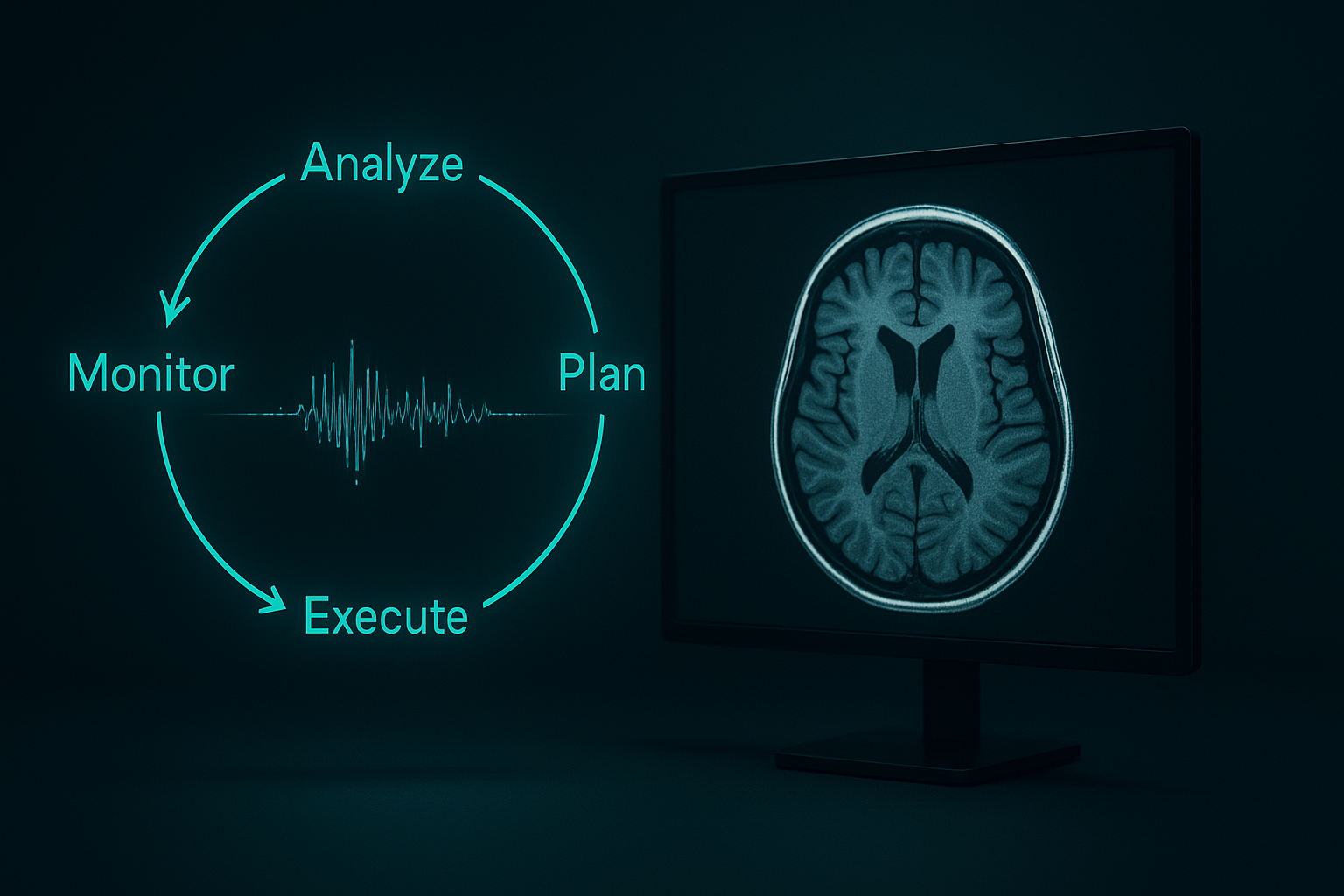
The MAPE-K loop, Monitor, Analyze, Plan, Execute, over a shared Knowledge base, originated in IBM's autonomic computing work in the early 2000s. In my research on adaptive self-healing AI for clinical decision support, I have found it to be the most useful conceptual frame for reasoning about how a health AI system should respond to environmental change over time.
Here is how each phase maps to the clinical drift problem specifically.
Monitor
The monitoring layer collects signals from three levels: input data characteristics (feature distributions, missingness patterns, device metadata), model behavior (prediction confidence histograms, output class frequencies), and downstream clinical process (order rates correlated with model outputs, override rates from clinicians).
The last category is underused in most implementations. Clinician overrides are a high-signal behavioral indicator of model degradation. If a model's recommendations are being overridden at an elevated rate for a specific patient subpopulation, that is distributional signal that no purely statistical drift metric will catch early.
For pediatric contexts specifically, the monitoring layer must be age-stratified. A neonatal subpopulation and a five-year-old subpopulation may show completely different drift profiles even within the same hospital system, because their physiological feature distributions are genuinely different and may shift for different reasons.
Analyze
The analysis phase is where you move from raw signals to hypotheses about the cause of drift. This is non-trivial. You need a taxonomy of plausible drift causes and a lightweight classifier or rule set that can distinguish between them.
In practice, the causes I encounter most often are: equipment or protocol changes (sudden onset, affects specific feature subsets), seasonal or demographic shifts in the patient population (gradual onset, affects aggregate statistics), data pipeline bugs (sudden onset, affects multiple features simultaneously), and genuine epidemiological change (gradual, affects label distributions).
Each cause has a different remediation path. You cannot treat them uniformly. Analyzing whether a shift is more consistent with a sensor calibration change versus a population composition change requires integrating metadata from the hospital's operational systems into the knowledge base. This is where most academic MAPE-K implementations fall short: they treat the knowledge base as a static artifact rather than a living integration point.
Plan
The planning phase generates candidate adaptation actions and evaluates them against constraints. This is where the regulatory surface area matters most.
In my architecture, the planner operates against a constraint graph that encodes: what adaptations are within the predetermined change control plan, what the minimum validation dataset size is for each adaptation type, what clinical workflows require human-in-the-loop confirmation before an adaptation is applied, and what the rollback procedure is for each adaptation type.
For example, recalibrating a classification threshold is a low-risk adaptation that may be within scope for fully automated execution if the recalibration dataset meets a minimum size requirement and the new threshold does not cross a predefined safety boundary. Retraining the underlying model on new data is a higher-risk adaptation that requires staging, shadow-mode evaluation, and clinician review before promotion to production.
The planner produces a ranked action list with associated risk scores and required approvals, not a single decision. This preserves human-in-the-loop oversight without requiring human review of every monitoring cycle.
Execute
Execution in a regulated context means blue-green or canary deployment semantics applied to model artifacts, with automatic rollback triggers tied to both technical metrics and clinical process metrics. A model update that causes a spike in prediction latency above a safety-critical threshold, or that causes clinician override rates to increase within the first 48 hours of deployment, should roll back without manual intervention.
The execution layer also writes to the audit log in a format consistent with FDA post-market surveillance requirements. Every adaptation, its trigger evidence, its validation results, and its clinical impact measurement, should be reconstructible from the audit trail.
What Fails in Practice
The hardest part is not the architecture. It is the knowledge base.
A MAPE-K loop is only as good as the knowledge it operates against. In clinical environments, the knowledge base needs to encode relationships between equipment configurations, patient population characteristics, clinical protocols, and expected model behavior. This knowledge is distributed across biomedical engineering teams, clinical informatics teams, and data science teams who have historically had very little shared infrastructure.
Building the integration layer to populate and maintain the knowledge base is more expensive than building the control loop itself. It requires data governance agreements, HL7 FHIR or proprietary EHR integrations, and ongoing curation by people who understand both the clinical context and the model behavior.
I have also found that the analysis phase tends to accumulate technical debt faster than any other component. The drift cause classifier that was accurate at system launch is itself subject to drift as the clinical environment evolves. You end up needing a meta-level monitoring process for the monitoring system, which is either a sign of good engineering or an early warning of infinite regress, depending on how you bound it.
Practical Takeaways for Health AI Engineers
If you are building or evaluating adaptive clinical AI systems, here are the decisions that matter most in practice.
Design your change control plan before you design your adaptation pipeline. Know which classes of adaptation are pre-approved, which require staged review, and which require full resubmission. This shapes every architectural decision downstream.
Instrument clinician behavior, not just model outputs. Override rates, query rates, and time-to-action are lagging but high-signal indicators of model trust and performance that purely statistical drift metrics will miss.
Build the knowledge base as a first-class system component with its own data ownership, schema versioning, and update cadence. Treating it as a configuration file is the most common architectural mistake I see.
For pediatric populations specifically, stratify every monitoring metric by age band. The developmental heterogeneity of pediatric patients means aggregate statistics will mask subgroup drift that has real clinical consequences.
And finally: the goal of a self-healing system is not to remove humans from the loop. It is to ensure that humans are in the right loop at the right time, reviewing the adaptations that require judgment rather than every monitoring cycle. Get that balance wrong in either direction and you either create alert fatigue or create autonomous behavior that your regulatory framework did not sanction.